
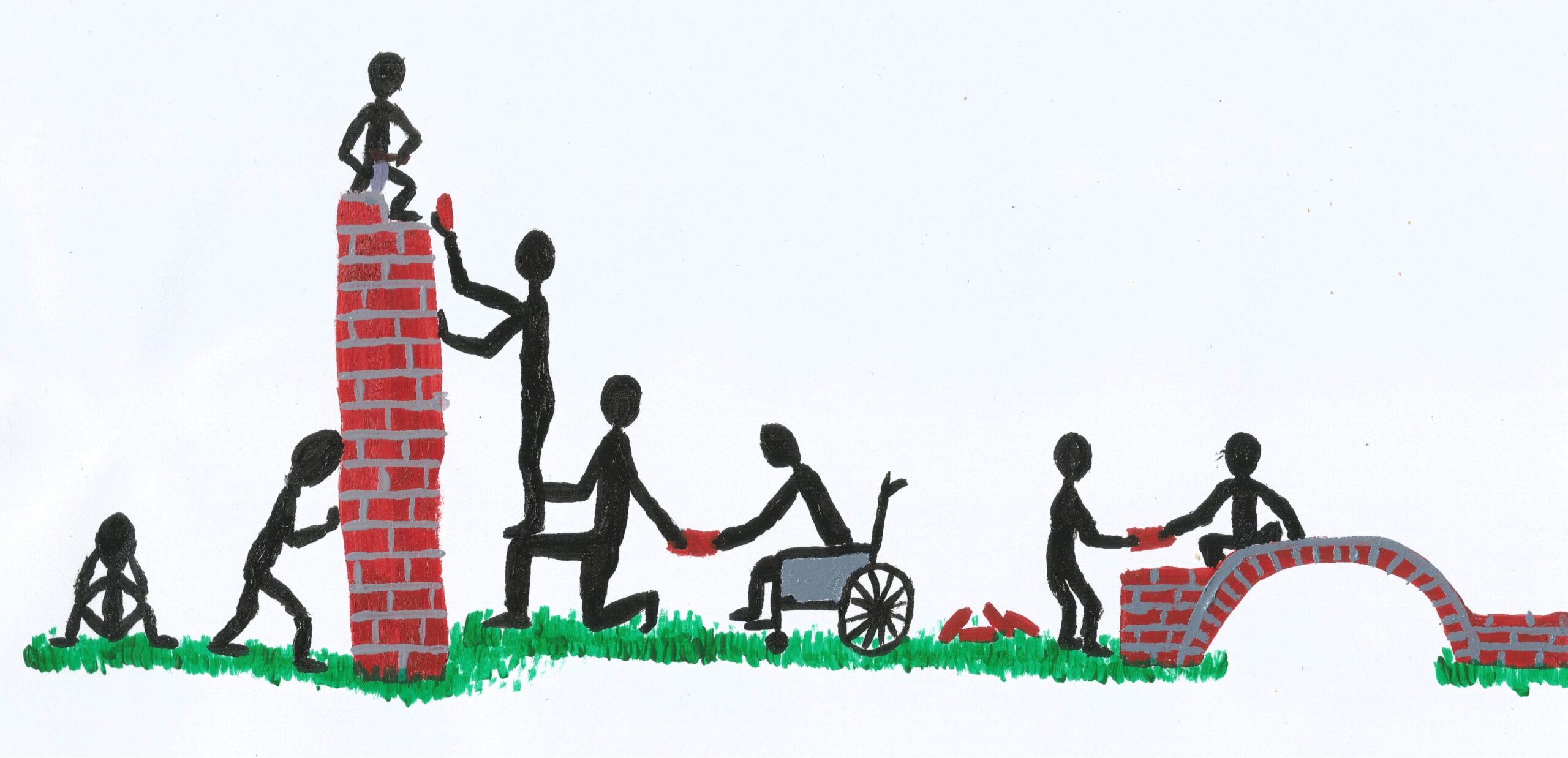
I am seeing more and more marches, rallies, and demonstrations planned, in different countries this month, against hate, racism, and crumbling democracies. On the one hand, this is heartening. To see people stand up, stand together, and stand against injustice and aggression gives hope. It makes me, and many others, feel less alone. But then, there is the other hand. It also makes me feel somewhat uneasy. Not because I object to these acts of solidarity and principle, but out of worry about the shape they may take.
Inequality, inequity, discrimination, racism, islamophobia, anti-semitism, homo- and transphobia, misogyny, anti-gypsyism, and ableism are all terrible and feel so unnecessary to me. I want them gone. However, I recognise that they do not appear out of nowhere. They are all grounded in fear and pain. They are part of the protective coping mechanisms of the people who express and/or embody these convictions. They are manifestations of the Trauma Wall. These convictions come from trauma reactions such as a fear of the unfamiliar, a supercharged sense of ‘us versus them’, dehumanisation, a need to control, and misinterpreting cues as threatening. All of these coping strategies were once necessary and appropriate adaptations, developed to survive extremely difficult circumstances. When the sense of threat does not go away – due to constant uncertainty, financial pressures, ongoing violence in the surroundings – and/or has never had a chance to be processed, the coping strategies persist and are easily recruited – and exploited – by others who either share similar histories and coping mechanism or by those who don’t but who see the potential of increasing power or financial gain by appealing to these coping mechanisms.
None of this makes what is happening acceptable. However, it does make it understandable. What’s more important is that it provides some insight into what would and what would not be effective ways to achieve change.
In a limited sense, trauma awareness and trauma-informed practice are increasing and spreading. However, they are very often applied in a one-sided way: the trauma of the child is acknowledged, while the parents are judged as failing; the trauma of the victim is recognised, while the perpetrator is simply branded malicious or evil. There is no interest in looking at the roots of the behaviour of the other party. Interestingly, this in itself may be a trauma reaction, a supercharged ‘us versus them’ lens.
When we do look deeper and recognise undesirable behaviour as a form of communication of what is hidden below the level of consciousness – as we are diligently starting to do with children, just not with adults, and certainly not with members of the far right – it becomes clear that being punitive, judgemental, and shaming when encountering those behaving that way can never bring about the change we are looking for. It can only increase the sense of ongoing threat, the felt need to defend, and confirm that now more than ever, the established protective coping mechanisms are essential for survival. When you come at the trauma wall (whether in an individual or within society) with sledgehammers and chain saws, the only thing you can achieve is further building and reinforcing the trauma wall. You will make it thicker and higher.
This is where my unease comes from when people are called to rally for a counter-protest. For those on the side of the protesters, it feels reassuring to see so many others on your side. It feels like belonging and a tiny sliver of safety. For those who stand on the other side, it feels like a major threat, a confirmation that the enemy is big and near, that there is a need to fight harder. The sense of threat and the reality of further polarisation increase when a protest and a counter-protest meet. Both sides feel under threat, and both sides operate with highly activated stress response systems and activated protective coping mechanisms. This makes it almost inevitable that escalation and even more threat, danger, and aggression will occur. It becomes a cycle that is very hard to escape.
I am not saying don’t march. What I am asking is, please do your best to march peacefully. Do what you can to recognise what lies beneath the convictions of the other side. Hate towards others is not simply a position that was decided on. It is a coping mechanism with roots in previous experiences. This does not mean that you should just accept abuse hurled at you or allow yourself to be harmed. Your safety is important, and so is theirs. Do what you can to help yourself and those around you to stay as regulated as possible to enable you not to dehumanise ‘them’.
Hate will never conquer hate. Violence will never win over violence. If we want to see these convictions and sentiments disappear, we need to find a way to build bridges, not to hit them harder than they hit us. We have to find ways of identifying common ground, and to help people feel heard and safe enough that their bodies do not feel the need to hide behind defences and resort to coping mechanisms. We can get there, but it is not easy.
On a different note, with this blog, the blog spot on my website has turned, once again, into a sandbox for the development of my next book. I’ll keep you posted on that.
Please share this blog to help raise awareness.